
| RECENT | Voting Accessibility: A Challenge to Every VoterBlog 50, October 2026 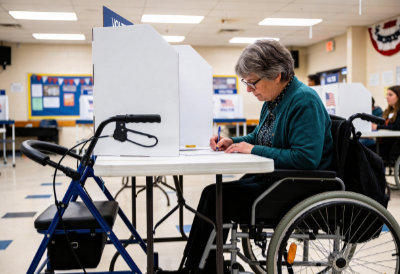 The next time you vote, take a moment to look beyond your own experience. From the parking area to the voting booth, what might stand between another voter and their ballot? Think of someone you love who uses a wheelchair or walker, has limited strength, or is recovering from surgery. Picture that person making the same trip through your polling place. Could they navigate the entrance? Open the doors? Move through the building? If a physical barrier made it difficult—or impossible—for them to cast their ballot, would you accept it? Now apply that same standard to every voter. For some readers, these questions describe a familiar reality. For others, they may bring an overlooked problem into focus. Either way, noticing a barrier should be the beginning of a response. Rutgers University researchers estimated that 40.2 million Americans with disabilities would be eligible to vote in 2024, a 5.1% increase over 2020. In research examining the 2022 election, the U.S. Election Assistance Commission (EAC) and Rutgers found that 19.9% of voters with disabilities experienced some difficulty voting in person, compared with 6.1% of voters without disabilities. Those difficulties extended across the voting process, but physical access is one essential place to start. Depending on where you live, your polling place might be a government building, church, school gymnasium, or another community facility. Each setting presents different conditions. An entrance you pass through without a second thought may require considerable effort from someone else. Potential barriers include inaccessible parking, uneven walkways, steps, and inadequate ramps. A heavy manual door can present another obstacle. Consider what opening that door requires. A voter using a wheelchair may need to approach the handle, reach for it, pull the door open, and reposition the chair while holding the door clear. Someone using crutches or a walker may have to manage the same task while relying on their hands for balance and support. Getting through the front door may sound like a small part of voting. For someone with limited mobility, however, it can be the first significant obstacle. Properly installed and maintained automatic doors can remove the need to pull or push a heavy door while maneuvering through the entrance. They can also make entry easier for people with limited upper-body strength or dexterity, reducing the need to ask someone else for help simply to get inside. A polling place can have an accessible voting machine and a well-designed interior and still cause problems for certain voters at the entrance. Accessibility is only as strong as its least accessible step. For election officials and facility managers, automatic doors deserve consideration as part of a broader accessibility review. Improvements to entrances can benefit residents throughout the year, whenever those buildings host community meetings, programs, and other activities. For every voter, the challenge is to pay attention—and follow through. On your next visit, look at the entire route: accessible parking, walkways, ramps, entrances, interior doors, and the path to the voting area. If an automatic door is provided, is it working? If it uses a push button, is that button easy to reach? If there is a separate accessible entrance, is it clearly marked and available? If you notice a barrier, tell a poll worker or supervisor promptly. Report the specific location and problem to your local election office. Ask what can be done to address it. Follow up afterward about a lasting solution. You do not have to wait until Election Day to raise a concern. The U.S. Department of Justice’s ADA Checklist for Polling Places offers a practical starting point for identifying barriers. Communities should also involve voters with disabilities in evaluating access and planning improvements; their real-world experience can reveal problems others overlook. As you leave your polling place, ask yourself: Could the person I pictured get through these doors and cast a ballot? If you are unsure, ask questions. If you see a barrier, speak up. Every eligible voter deserves access—and none of us should have to encounter an obstacle personally before taking action. The next time you vote, look at your polling place through someone else’s eyes. If you notice a barrier, call attention to it. Doing so could help make the path to the ballot more accessible for everyone. SHARE ON: |
| Voting Accessibility | |
| Voting Accessibility | |
| The Front Door Is Your First Impression | |
| July is Disability Pride Month | |
| AAADM Celebrates Building Safety Month | |
| Sharing is Caring | |
| Why We Celebrate National Automatic Door Day | |
| Why Automatic Doors Are a Strategic Investment for Restaurants | |
| 2025: Year in Review | |
| Opening Doors to Inclusion: Automatic Doors Reflect the Values of International Day of Persons with Disabilities | |
| National Disability Employment Awareness Month Celebrates 80 Years; Our Industry Does, Too. | |
| Absent Mandates, Automatic Doors Still Best for Schools | |
| AAADM Adds 'Building Code Tracker' to Website; Lists States Embracing IBC Accessibility Mandate | |
| Opening Doors to Better Healthcare: The Power of Automation | |
| Disability Pride Month 2025 | |
| AAADM Joins PASS for Safer Schools | |
| Automatic Doors Add More 'Service' to Foodservice | |
| Five Years of 'Magic': National Automatic Door Day | |
| 2024: Year in Review | |
| International Persons with Disabilities Day: Enhancing Accessibility for All | |
| Vote for Accessibility: Removing Physical Barriers at Polling Places | |
| Opening "Automatic" Doors for Employees with Disabilities | |
| The Modern Office Building in a No-Touch World | |
| Summer's Here and the Time is Right for ... Addressing School Access | |
| July is Disability Pride Month: Why Aren't Automatic Doors Mandated by the ADA? | |
| The Important Work of the U.S. Access Board | |
| Rolling Out the Red Carpet for National Automatic Door Day | |
| New Certification Program for 2024 | |
| International Persons with Disabilities Day | |
| The Right to Vote | |
| The Modernity and Aesthetics of Automatic Doors | |
| July is Disability Pride Month | |
| A Lot to Learn | |
| ASSA ABLOY's Dave Timmerman is New President of American Association of Automatic Door Manufacturers | |
| Automatic Doors: Champions of Access | |
| AAADM Leadership Delivers U.S. Access Board Webinar | |
| AAADM at 30: Safety is the Great Uniter | |
| Philadelphia Freedom | |
| Door Doctors | |
| Safe With Us | |
| State of the ADA | |
| A Clear Path to Voting | |
| "GREEN" Doors: Earth Day and Automatic Doors | |
| Do the right things, get money back | |
| The Second Annual Automatic Door Day | |
| FOOD FOR THOUGHT Restaurant patrons overwhelmingly say they want automatic doors | |
| My Electrician Says He Can Fix My Automatic Door. Should I Let Him? | |
| Automatic Doors Have Graduated Beyond Entryways | |
| Greet Your Guests in the New No-Touch World | |
| Automatic Door Day | |
| IBC Building Code | |